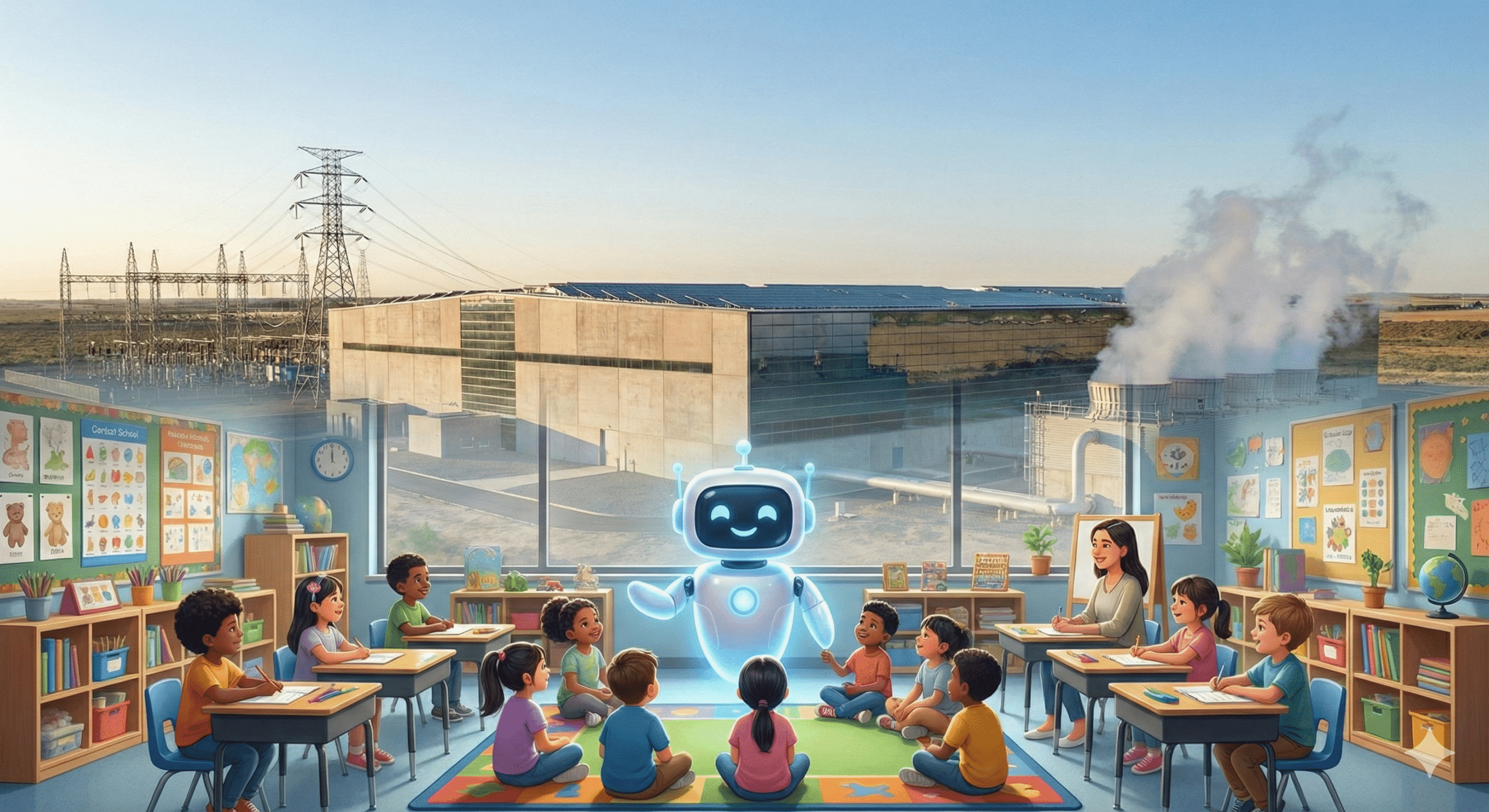
Earlier, I wrote about Generative AI water and power use. I keep trying to rationalize its use in the context of our personal use of electricity and gas, which is far less than any of our neighbours (at least half as much use). Our personal impact on the environment drives us: we recycle everything, conserve water frugally (60% less), use half the electricity of others near us, and drive only when we have multiple reasons to. So what’s wrong with splurging a little on AI use? It’s about the balance of things, right?
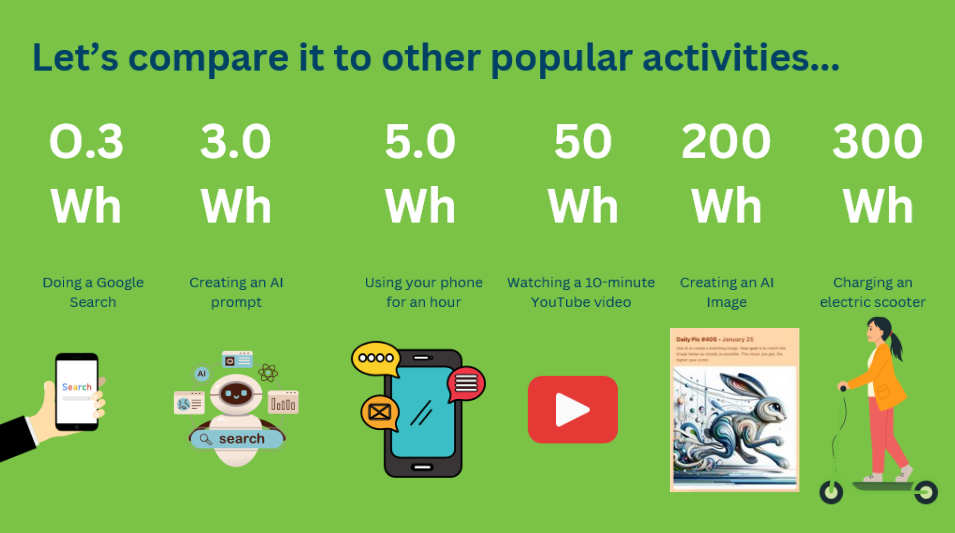
Cari Wilson, of Focused ED Resources and an educator in West Vancouver, shared the same thought and showed us a good slide deck on AI literacy that had slides on power and water use. Also, some of our EDCI 336 students have posted lots of good resources on AI’s environmental impact (such as the federal government resources).
I wrestle with guilt as I encourage new and veteran educators to use AI, to learn about it so they can teach students to use AI ethically and effectively, as it pervades every facet of our daily lives. Yet, that at least doubles their use immediately, as I have found. How can we avoid it and simply teach them how to create lesson plans, learning activities, assignments, and assessments using the tools and content we already have available to us? Stay away from Gemini, ChatGPT, and Claude to preserve our depleting water and power.
Then, I wonder if there is a clear answer or solution to the dilemma of whether to use AI or not. It seems, though, that with all the hype and attention on AI, its pervasiveness, we really don’t have a choice. Both parents’ and teachers’ primary roles are to teach. We teach children to speak, walk, respect others, ride bikes, learn to read and write, and even drive cars. Why is it not the first thing on our minds to teach them about tech and AI? Yes, in an age-appropriate manner.
However, do we really know and understand what has been unleashed in our time, our children’s and even our grandchildren’s environment? Could we ever shirk this responsibility? So, maybe we don’t have a choice? Can we trust big tech companies and their investors to protect our power and water when it affects their bottom-line profits? Not if Sam Altman, CEO of OpenAI’s ChatGPT, states that training and using AI has far less environmental impact than training humans. How soon are we going to be sequestered to cocoons as depicted in The Matrix?
I found that even more AI tools are being added to applications in Google, beyond just Gmail, Chrome/Google browser. Google is embedding Gemini, and likely its agentic capabilities, soon here in Canada, into a plethora of its existing Google for Education tools. I watched a Google Education Canada overview (video and slides) and cringed. Not to be outdone, Perplexity, through its Comet browser, was promoting agentic AI directly to students in the early Fall (see a blog post on this by Marc Watkins, where he provides examples of agentic AI answering questions in Canvas).
Maybe we are being forced to put our energy into public agencies, pushing for change and regulation of the unchecked growth and competition that could burst before we know it. However, after meeting with US Defense Secretary Pete Hegseth who delivered an ultimatum to Anthropic (the only AI company that publicly vowed, and had a policy to never to publish new AI developments without having firm guardrails in place) to roll back the company’s AI safeguards for military use, or face serious consequences, Anthropic published its rewritten responsible scaling policy (RSP). This was Anthropic’s bid to preserve its $200 million Pentagon contract. Given that Anthropic was the last major AI lab with a hard (perhaps now soft) safety commitment, there is now no major AI company with a binding promise to stop AI production if they cannot control it. And yet, late February news may hold out some hope on this, but the tech giants are forced to pick sides. Another news item on the last day of February indicates Anthropic dug in, and is now out, but OpenAI and Google carry on supplying the US “Department of War”. See The Conversation post for additional details regarding President Trump’s statement and OpenAI’s response. Anthropic is now challenging the Trump administration’s response in court.
Now, the very institutions that could protect us may be the source of the problem. I fear, now, there is no escaping from AI domination and all the havoc and destruction it may bring…