Conversations & News

October Newsletter

AI Café, Conversations, Research, and Resources

Two ghosts

As Fall weather, Thanksgiving, and professional learning events loom, October is another busy time for educators. Check out our latest resources and updates, including:

  1. Posted Blogs and podcasts continue on a regular basis.
  2. Offering new initiatives like our AI 4 Families pilot project (complete with useful resources).
  3. New research: Our Critical Supports Study continues.
  4. Previous research and studies are published on our Projects page.
  5. The State of the Nation: K-12 e-Learning in Canada website.
Scroll down for info and check out the latest news and learning events.


We continue to serve our network and community, but we need your help. Join us as an organizational member or individual member. Your membership and contributions will help us to keep online and digital learning in the forefront of educational improvement. 

Fuel your passion! Join us to be the change in digital & online learning.

Check out our podcast series:

Check out others here.

CANeLearn Partner Events: Check them out!

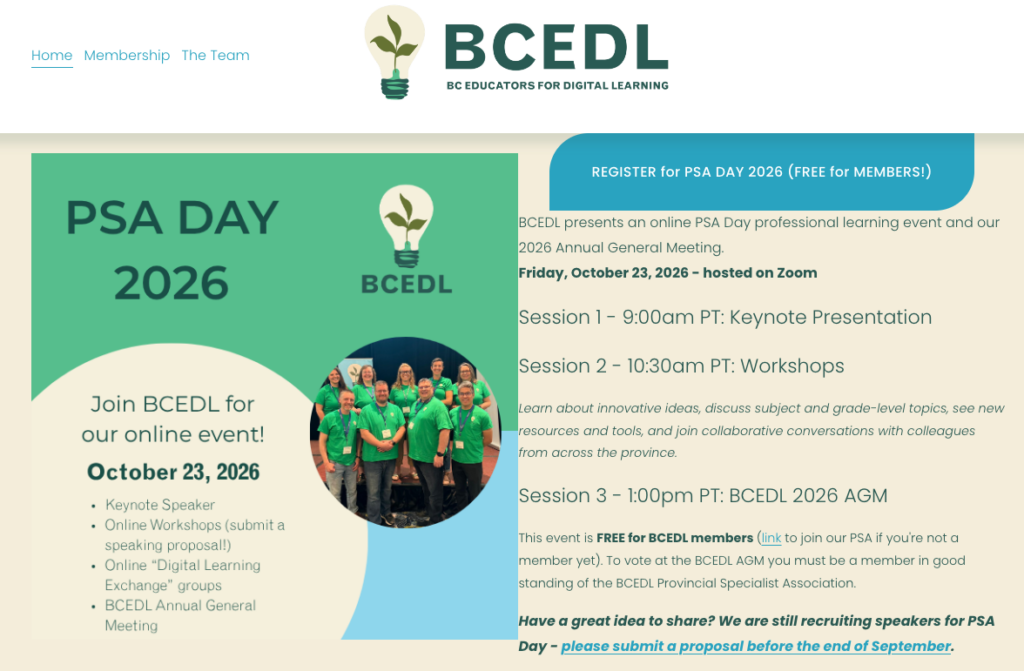
BCEDL Digital Learning Symposium April 2027

Save the Dates!

BC Educators for Digital Learning invite you to join CANeLearn network folks at the 24th Annual Digital Learning Symposium in Vancouver April 21-23.

  • A dynamic event attended by professionals actively engaged in the development, organization, administration, and delivery of tech-enabled and digital learning programs for learners across BC, Canada, and beyond. 

Calls for proposals coming soon!

In Other News...

Michigan Virtual Learning Research Institute:

Recent Publications

Any time, any place, any pace: How time, place, and pace converge

The final report in a five-part series exploring flexibility in online learning and its relationship to student outcomes.

AI in Education: A 2026 Snapshot of Growing Use and the Shift Toward Integration

A 2026 Michigan Virtual study provides an updated look at how educators are using and thinking about artificial intelligence in K-12 education.

Artificial Intelligence and Student Usage in Online Learning: A Longitudinal Analysis of Usage Patterns, Achievement, and Perceptions in K-12 Virtual Education

This study follows more than 26,000 Michigan students over two years to see how they actually use AI in their online courses—and what happens to their grades when they do. AI adoption nearly doubled, with sophisticated “tool + tutor” use growing fastest, especially among high-achieving students. 

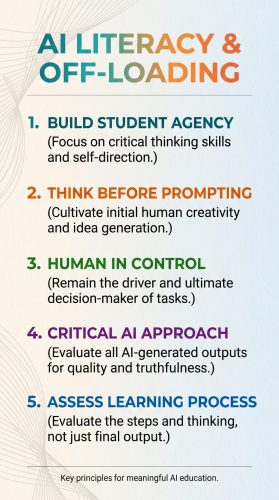
Are we teaching AI literacy, or are we just teaching students how to outsource thinking more politely?

A discussion from AIeducator.tools

  • AI literacy prioritizes student agency—the ability to question, critique, and explain decisions—over mere tool access, efficiency, or productivity.

  • Students must engage in independent cognitive struggle and generate their own ideas (“prompt the human first”).

  • Effective AI integration requires an intentional, iterative back-and-forth process where the student remains in charge, actively deciding what outputs to keep, reject, or adapt.

  • A crucial skill for students is determining the appropriate mode of AI use, maintaining the critical distance necessary to treat AI as a flawed tool rather than an infallible oracle.

  • Educators must shift focus from assessing final products to evaluating the entire learning process through checkpoints and reflection.

Read more here.

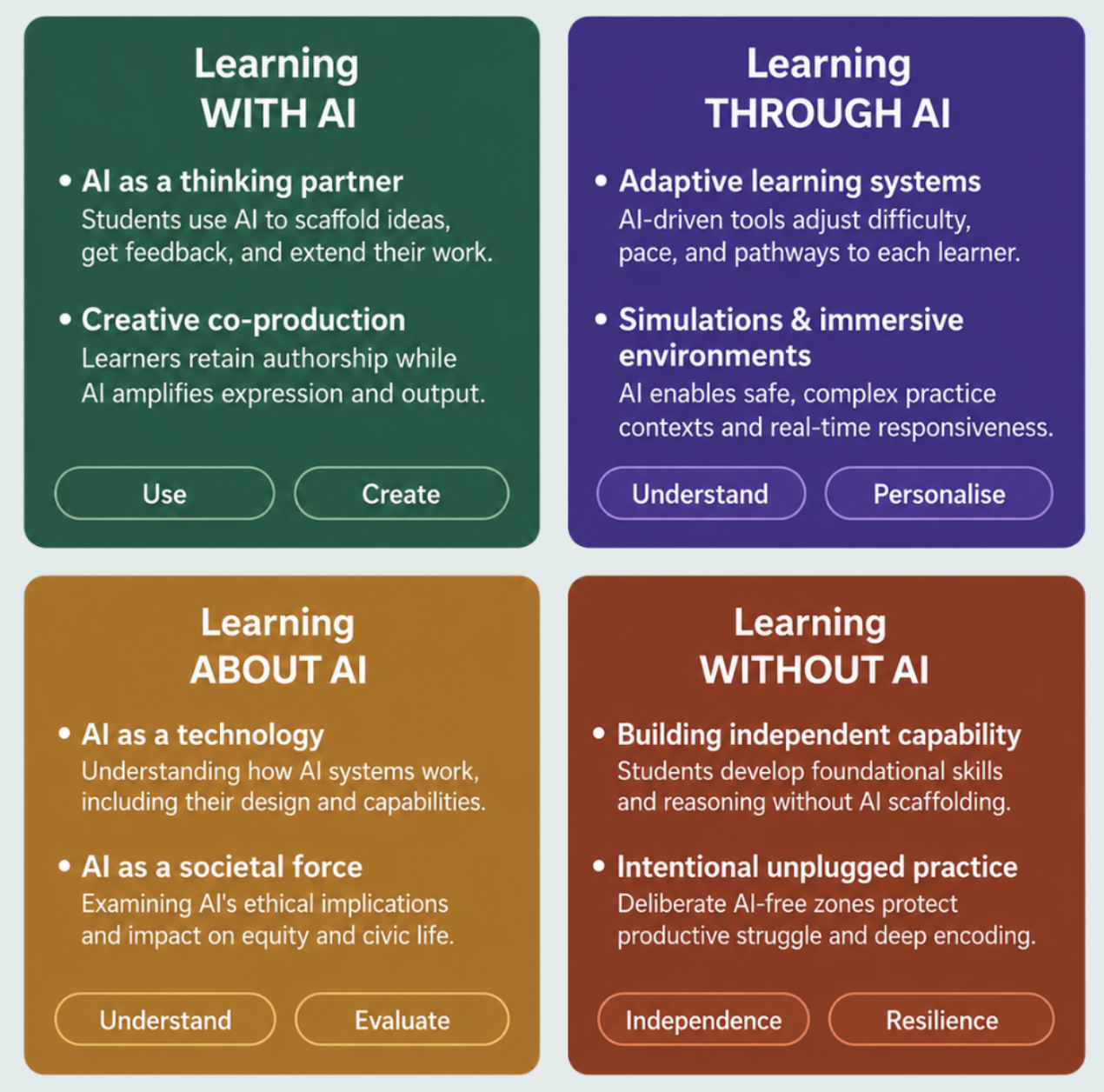
Graphic of Learning with AI, Through AI, About AI, and Learning Without AI
New Brunswick is weaving AI into its K-12 curriculum,
drawing praise — and pushback

Digital education in New Brunswick is grounded in the following principles:

  • Technology should support and enhance pedagogy and curriculum outcomes.
  • Technology skills exist on a continuum. All learners and teachers are capable of enhancing their technology skills.
  • Digital and AI tools should enhance, not replace, human thinking and creativity.
  • Ethical, safe, and responsible participation in digital environments is essential.
  • Students require balanced opportunities to use, understand, create with, and critically examine digital and AI technologies.
  • Digital literacy competencies are transferable and enduring, even as specific technologies evolve.

Check out the AI policy here.


CANeLearn Research Publications

  • Ongoing research from partners and CANeLearn’s own studies are published here


The AI Café is for families. Two grandfathers and two cheeky chatbots tackle how parents can make homework hour at the kitchen table a learning experience.

The pilot program (free) starts in October. Share with your parents if it is of interest.  

See our pilot project site.
Share the one-page overview.
Conversations with Grandchildren
Program Leaders Data Survey
  • The State of the Nation report has been an identifying study for almost 20 years.
  • Online program data collected complements ministry information, enabling cross-referencing, trend ID, and sharing. 
  • Survey responses are at the bottom of jurisdiction profiles (e.g. https://k12sotn.ca/bc/)
Click here to add your data to improve the renowned study.


Fuel your passion! Join us to be the change in digital & online learning.

All images, unless otherwise noted, were created using Gemini. Nature & other photos from @rlabonte.

Login