What About the Parents?
When Students Revolt, Educators Defend the Status Quo, and Parents Remain Silent
October 30, 2026
Michael J. Canuel, Ed.D.
In October, the streets of Europe erupted. Students were protesting, and the grievances were piling up faster than politicians could manufacture reassuring statements about their commitment to education. Closer to home, students are similarly making their frustrations heard. What exactly are these young people protesting? Take your pick. Overcrowded classrooms, teacher shortages, deteriorating buildings, restrictions on cell phones, inadequate resources, and an assortment of other grievances that, depending on whom you ask, range from entirely legitimate to hopelessly misguided.
Student protests are hardly new. Young people have challenged authority for generations, occasionally with remarkable results. I suspect we are witnessing the early symptoms of another profound crisis of relevance. I admit I cannot prove this hypothesis. My evidence is largely anecdotal, gathered through conversations with friends, family, acquaintances, and the unsuspecting individuals I encounter while walking my dog. The world is changing at a speed that leaves people increasingly uncertain about what tomorrow will look like, while our educational institutions continue behaving as though the future has generously agreed to wait until the next curriculum revision.
Artificial intelligence is accelerating this uncertainty, transforming how we access information, solve problems, communicate, create, and increasingly perform work once considered the exclusive domain of human intelligence. None of this is happening in secret. There is no conspiracy, no mysterious technological coup. The revolution is unfolding in plain sight.
And yet, the education system seems determined to greet it with another committee, another policy document, and perhaps a professional development afternoon featuring coffee, muffins, and a PowerPoint presentation explaining why innovation matters. How are we going to persuade students to return obediently to an educational experience built around yesterday’s assumptions once they have discovered what artificial intelligence makes possible?
We aren’t. This does not mean that AI automatically makes students smarter, that every technological innovation improves learning, or that teachers have suddenly become unnecessary. Far from it. UNESCO’s 2023 Global Education Monitoring Report warns that educational technology must be judged by evidence of learning, equity, and sustainability rather than technological enthusiasm.
But that is precisely my point. If technology can increasingly provide information, explanations, examples, and immediate feedback, why do we continue organizing so much of schooling around the delivery, memorization, and reproduction of information? Why are we not devoting more attention to developing the human capacities that make such technologies useful: critical thinking, sound judgment, creativity, communication, ethical reasoning, and the ability to distinguish a convincing answer from a correct one?
The problem is not that students no longer need to learn; it is that they need to learn differently, and our institutions are having a remarkably difficult time managing that distinction. The current system rewards compliance, protects established routines, and too often treats meaningful change as an administrative inconvenience. The system functions to maintain stability and, while principals monitor completion rates, some educators attempt systemic change, but the system treats the attempt as a disruption.
Educational innovation certainly exists. We have exceptional schools, extraordinary teachers, imaginative programs, and inspiring examples of what learning could become. These examples are often paraded before the public like prize-winning livestock at an agricultural fair. Look! Innovation! Wonderful. But show me where it has become the norm.
The uncomfortable reality is that promising educational practices do not automatically become standard practice. We have become remarkably proficient at celebrating isolated examples of educational excellence while leaving the machinery that makes them exceptional largely untouched. And so, the question becomes: if students are increasingly dissatisfied and institutions struggle to transform themselves, who is left to demand something better?
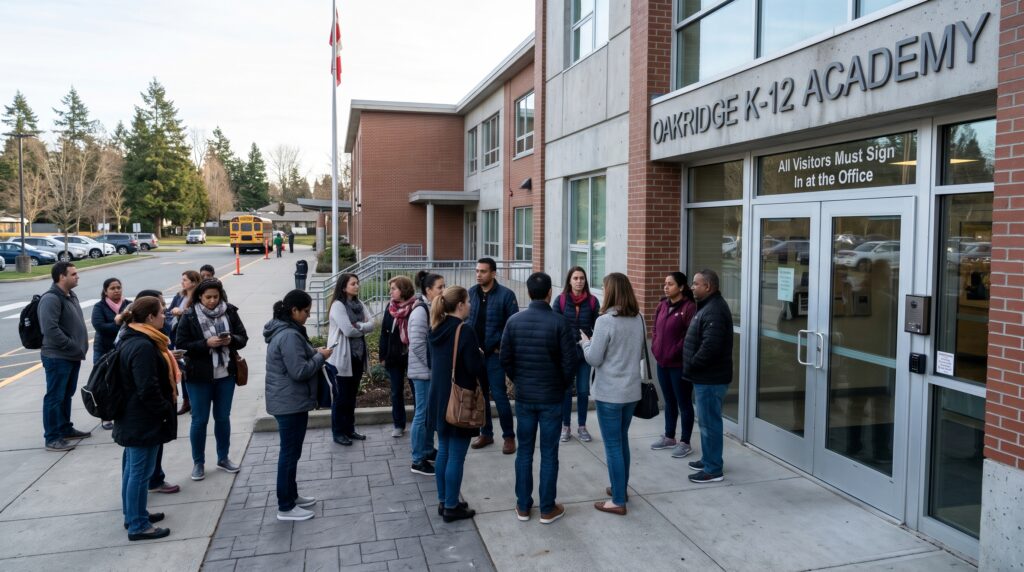
The parents are. Those people who produce the children, raise them, feed them, comfort them, encourage them, and eventually surrender them to an educational system over which they often exercise remarkably little meaningful influence. We invite parents to fundraising activities, encourage them to volunteer, ask them to supervise homework, but only occasionally permit them to participate in carefully structured consultations. Often the moment parents begin asking difficult questions about curriculum, pedagogy, or assessment, the atmosphere changes rather quickly. After all, what could parents possibly know about education?
To be fair, professional expertise matters. But expertise does not grant ownership of the public system. Credentials do not provide immunity from accountability. Parents live in the economy that schools claim to serve. They live and work in a world that schools are supposed to prepare their children to enter. They see the skills demanded in workplaces, the changing nature of employment, the importance of adaptability, and the consequences of technological disruption. They observe the gap between their workplace reality and their child’s online assignments. They are perfectly entitled and positioned to ask why certain educational practices have survived largely unchanged across generations, yet are to remain within the boundaries drawn for them.
There is a substantial body of research supporting the importance of parental engagement. The Education Endowment Foundation’s evidence reviews show that constructive parental involvement can contribute positively to children’s learning, although the effectiveness of different approaches varies. Admittedly, that research does not prove that parents should dictate curriculum or education policy, but it does demolish the convenient notion that parents are merely peripheral participants in their children’s education. They are essential participants.
In an AI-saturated world, what would meaningful reform actually involve? What evidence would demonstrate progress? What would change in classrooms, and when? For too long, educational change has been treated as an undertaking to be studied, piloted, reviewed, revised, and eventually reconsidered. Unfortunately, artificial intelligence has not agreed to respect those administrative timelines. Neither has the world of work. Neither have the social, economic, and intellectual challenges our children will inherit. And increasingly, neither have the students themselves.
I do not pretend that every student who may march through the streets is demanding a fundamental transformation of education. Many are protesting specific and legitimate conditions, and we should listen to what they actually say rather than conveniently interpreting their anger as an overreaction to our favourite educational theories. Their protests should prompt us to ask a much larger question. What happens when a generation begins to lose confidence that the institutions preparing them for the future actually understand that future? That is the question that ought to keep educators, administrators, policymakers, and parents awake at night.
I have spent much of my professional life in education, and I remain convinced that meaningful change is possible. I have also spent enough time watching institutions defend the familiar to know that possibility and probability are two very different things. Which brings me back to parents. You do not need a doctorate in education to recognize that the world your children will inhabit is fundamentally different from the one for which many of our schools were designed. Parents do not need to understand every detail of artificial intelligence to insist that schools take its implications seriously, and they should not need anyone’s permission to ask difficult questions about their children’s futures.
The future of education is far too important to be left exclusively to those who administer it. That future belongs to students, families, educators, and the society that depends upon them. Perhaps my expectations are unrealistic. Perhaps parents will continue to remain largely silent, reassured by the occasional innovation showcase and the annual declaration that everything is being done in the best interests of children. Perhaps our institutions will eventually discover a sense of urgency all on their own. Yet, I won’t bet my grandchildren’s future on it.
The students are making noise. The institutions are defending their routines. The future is arriving without waiting for permission. And the parents? They may be the last people with enough collective influence to demand a different future. The question is whether they will find their voices before their children discover that nobody was listening.
Bibliography
- OECD. (2026). OECD Digital Education Outlook 2026: Exploring effective uses of generative AI in education. OECD Publishing. https://doi.org/10.1787/062a7394-en. The report distinguishes AI-assisted task completion from genuine learning and argues for protecting independent thinking and foundational human skills.
- UNESCO. (2023). Global education monitoring report 2023: Technology in education—A tool on whose terms? UNESCO. Official report. Supports your criticism of poorly evaluated innovation and the difficulties involved in implementing educational technology at scale.
- OECD. (2024). PISA 2022 results (Volume V): Learning strategies and attitudes for life. OECD Publishing. OECD findings on mathematics anxiety. Provides documented evidence of students’ anxiety surrounding mathematics, performance, and examinations.
- Education Endowment Foundation. (2025). Parental engagement. Teaching and Learning Toolkit. Official evidence summary. Summarizes research on the contribution of parental involvement to student learning. It does not, however, establish the effects of parental participation in curriculum governance.
- Education Endowment Foundation. (2021). Teacher feedback to improve pupil learning. Official guidance report. Documents the importance of formative assessment and actionable feedback, providing a useful evidence-based counterpoint to an excessive reliance on summative assessment.
- Associated Press. (2026, October). Policing of France’s school protests clouds Macron’s final months and sparks uproar. Read article. Contemporary reporting supporting the opening discussion of student protests in France.